
One in 2000
- Description
- Reviews
- Citation
- Cataloging
- Transcript
Every parent-to-be hopes for a 'perfect' baby, but what does that actually mean? Every newborn is different, but some of those differences are scarier to parents than others. Each year an estimated one in two thousand babies are born with anatomy that doesn't clearly mark them as either male or female with what is known as an intersex condition. It's a situation that's hard to talk about; it challenges our preconceptions about how things are 'supposed' to be.
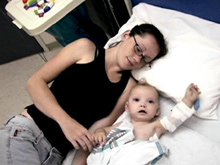
This provocative documentary demystifies the issue of sexual difference. At a time when five babies a day in the United States are having 'gender reassignment' surgery, it argues that there is little evidence that such surgery is beneficial to the child. The program profiles several people born with ambiguous sexual anatomy, who have managed to deal with some very difficult family and social issues, but today are living 'ordinary' and productive lives. It also includes a young mother who is matter-of-factly creating the conditions for her intersex baby to do the same.
Interweaving their stories with educational films from the 1950's, One in 2000 invites us to take a serious second look at how the media have dealt with sexual 'normality.' It will be an invaluable tool for educating and sensitizing parents, young people and many in the medical community as well.
'One in 2000 demonstrates that the umbrella term 'intersex' covers a huge range of bodies and experiences. It shows that truly effective care for intersex people means recognizing that there are many paths to health and happiness, and that the real experts are the people themselves. The program should be required viewing for every doctor, advocate, and academic dealing with this issue.' -Thea Hillman, Intersex Advocate; Author of For Lack of a Better Word'; Former Board Chair, Intersex Society of North America
Citation
Main credits
Clearway, Ajae (film director)
Other credits
Cinematography, Lisa Kaselak [and 3 others]; editor, Aja Clearway; composer, Lisa Schneider.
Distributor subjects
Adolescence; Body Image / Obesity / Eating Disorders; Captioned Films; Community and Public Health; Ethical Dilemmas; Fanlight Collection; Genetics; Issues and Ethics; Men and Women / Gender Issues; Psychology; Social Work; Women's Health IssuesKeywords
One in 2000
[00:00:02.81] Dad, How can Aunt Helen and Uncle Jim have a baby if they don't know what they want?
[00:00:10.94] Oh, it doesn't matter, Johnny. They'll love their little baby whether it's a boy or a girl.
[00:00:35.57] When babies are born, you expect to hear in that delivery room, congratulations, you got a girl or congratulations, you got a boy. When some babies are born, it's congratulations, oh, shit, we'll get back to you.
[00:00:55.90] When you're new parent, you just want what is best for that baby. And if a doctor comes into the room and says, we can make this baby better with surgery, you did it. You just did it without asking questions. I mean, the whole doctor-patient relationship was different then. The knowledge wasn't out there. And you did it.
[00:01:17.58] How will you choose to intervene in the ancient designs of nature from man? Would you like to control the sex of your offspring? It will be as you wish. Would you like your son to be six feet tall, seven, eight feet?
[00:01:35.10] We think about children as commodities. We want them to be perfect. We want them to have the right hair color, the right eye color, to have no conditions that are going to cause them any problems. And that's not the worst thing in the world. I mean, as a parent of course, if you're carrying a child, you want that child to have every option in life and to be as healthy as possible and all of those things. But there's a cost to that thinking, which is that when people don't fit into that normal, perfect category, then what?
[00:02:02.05] [BABY COOING]
[00:02:24.22] Turner Syndrome is where, instead of having two x chromosomes to be a girl, you have one x and a partial x or one x and no other x. And she has one X and no other and x. So she has full blown Turner Syndrome. She won't hit puberty. She'll have to have growth hormones. She's in the bottom one percentile of how big she should actually be right now. And then, she'll have to have hormones to hit puberty once she's a teenager. She'll never be able to have kids.
[00:02:54.49] When I went through puberty, I knew they were something different because my parents took me to the doctors because I hadn't developed like other boys. And that was in 1960 and the doctor said, oh, he'll be normal and you'll be able to have grandchildren. But they didn't do any tests.
[00:03:15.64] I remember hearing her say-- and she denies this actually, but actually hearing her say, oh, when you were born, they thought you were a boy. [GIGGLE] And she laughed. And I don't remember if it was at a party and she had a couple of the drinks or something. I don't know how she let that slip, but I never forgot it.
[00:03:34.50] I was one with a condition called partial antigen insensitivity syndrome. And when I was growing up, like my mom would just say-- because I was very different from other kids. I was very tomboyish and you know, not like different, because there are a lot of young girls who are very boyish. But I was very boyish in a very different kind of way.
[00:03:57.27] I was born in June 11, 1963, Cook County Hospital. I think it was then that the doctors realized that I had hypospadias where the urethra was not at the tip of the penis like it's supposed to be. And a bifid scrotum where the scrotum isn't fused. It's like the labia. And so the doctors closed the scrotum, moved the urethra to the tip of the penis. Told my mom, OK, voila! You got your baby boy. And they told my mother then that I would have to be on hormone replacement later in life, because my body wasn't producing hormones, hence, why I didn't fully develop into a male.
[00:04:31.15] Well, I have MRKH, which is Mayer-Rokitansky-Kuster-Hauser syndrome. It's a bunch of dead guys who allegedly discovered it. And basically, like I was born without a uterus and without a vaginal canal or vagina. And it wasn't discovered until I was about 15, because I had been fully developed for quite some time and I never started menstruating.
[00:05:03.91] Jeanie, when you think I'll start having periods too?
[00:05:08.63] Oh, I don't know, pretty soon, I suppose. I was 13 when I started.
[00:05:15.39] Well, Peggy's already started hers and I'm six months older than she is. Well, so what? Some start earlier, some later. We're all different. From the way you've been acting lately, shouldn't be long now.
[00:05:30.45] I guess with doctors, one of the first questions they ask you when you have fainted is, are you pregnant? Do you think you're pregnant? When was the last time you had your period? And the doctor was shocked when I had said that I'd never had a period at 20 years old. And she couldn't understand. She was like, no, really. when? How long has it been? I'm like, you don't understand, never.
[00:05:52.43] I don't know, just like, as soon as she's like able to start understanding, I'll just like, start telling her, just so it'll be like normal to her. It's just be something she's used to because she's had it and she's known about it.
[00:06:12.74] They were shocked that I'd got so long about being diagnosed. They were mainly concerned with my heart, because being at risk for congenitive heart disorders. But they listened to my heart and said it was relatively fine. And then proceeded to tell me that I was missing an x and I most likely would never have children. They put me on hormone replacement therapy so that I could menstruate and develop female physical characteristics.
[00:06:52.41] How I understand it is that my body was sort of producing these very high levels of testosterone, however, my body can only absorb so much, and that the extra was sort of being converted to estrogen. So I was sort of experiencing this ambisexual development, which was like I had breast development, I had some hip development, but I also had muscle growth. And like I said earlier, just looking very masculine and being very aggressive and extremely assertive.
[00:07:29.37] He says you have Klinefelter's syndrome, which is xxy sex chromosomes. And he also said that you only have 10% of what's considered normal male hormone production, and that you need to go on hormone therapy.
[00:07:53.71] Back in the '50s and '60s, when John Money was at Hopkins and there was a whole team, and they looked at the psychological literature, and John Money is a psychologist, and behavioral literature said at that time that children are a blank slate. And that when they're born, you could raise them as a girl or a boy. And really, their behavior depends on the interaction with the environment. So as long as we raise them 100% like they're a little boy, and we have no question in our minds that they're a little boy, then they'll be a boy and it'll be just fine.
[00:08:24.81] I was trying really hard to be normal and she was trying real hard to tell me I wasn't normal. Whereas, I really could have used her just to say, you're normal, you're fine, you're all right. You just have a body that's a little bit different and here's what happened. And here's what occurred.
[00:08:41.17] It was a pretty big shock to me when I learned that I didn't have a clitoris and there was a lot of anger. You know, there was a lot of anger in that I felt at the time, that she allowed me to be damaged and harmed. And parents aren't supposed do that with their children.
[00:09:36.01] And if you've seen the surgery, it's just the most barbaric thing ever, like taking this little teeny clitoris and like splitting it open and cutting it down and sewing it back up. I mean, it's just the most horrifying thing you've ever seen. And you can't watch that and not think that the person's not going to have pain, let alone like numbness or anything else, or that they'd ever actually want to be touched there again.
[00:10:22.44] So at eight years old, I was short. My mother took me to University of Chicago Hospital and they start me on growth hormones. I was on growth hormones and other medicines. I was diagnosed with hypothyroidism, hypogonadism, hypoadrenalism, hypopituitarism, hypo, hypo. And so when I reach 14, puberty, where most boys, their voices are getting deeper and they are growing hair on their chests, my voice got lower and I started growing breasts.
[00:10:49.45] And so my mom's like freaking out. My mother is a single parent, minister, eight kids. So she's freaking out and she's like, whoa. So she took me back to University of Chicago Hospital where I was inpatient there a lot. And they said, well, you know, your son just needs some testosterone. So we're going to make this kid a boy no matter what.
[00:11:05.53] Kids sort of have a feeling that something isn't right. There's something that's not spoken about. Or I go to the doctor a lot. I don't get why. Or why do you make me take this medicine. And they'll think that there's something wrong that's much worse. So I've had kids say, do I have cancer? Or is this Ritalin? What are they doing to me?
[00:11:37.05] I have heard endless stories of people being lied to by their parents and doctors. I have heard of people being taken to the hospital with no idea why, and waking up the bandages around their genitals. I have heard stories of friends being born with genitals that had sexual function and sensation and then being given surgery that took both away. I've heard of people who received so-called repair surgeries, and then the next surgery failed and then the next surgery failed and then they were on their 16th surgery in 23 years.
[00:12:05.35] I've heard stories about loss of continence from surgery, chronic infections and illness due to surgery, and I've heard a stories of surgically created vaginas that leak, that smell, and that come unattached from the body. I've heard stories about repeated genital displays to medical doctors and students. And I've heard of families destroyed by the secrets and pain and shame. The stories about intersex treatment that I have heard do not center around being raised as the wrong gender, although this has happened to some people I know. What intersex people feel most scarred by is being lied to and being treated as if their bodies are freakish, shameful, and something to be fixed and then never spoken of again.
[00:12:43.69] I found out from my mother that I was born with a vaginal opening, but lacked internal female organs. I had cosmetic genital surgery to the close to the vaginal opening. I sent away for my medical records to the hospital where I was born, but they cannot find my old medical history.
[00:13:01.51] I've had doctors told me that abnormality is simply a descriptive word because it's not the norm, to which I always point out that it's actually is a biased word because children who are abnormally intelligent or born extremely intelligent or attractive are not deemed abnormal and operated on to reduce this variance from the norm. So it's not an abnormality, it's a variance.
[00:13:27.32] I guess that's the most hurtful part as a mother, is the feeling that your child who you know is such a wonderful human being will be looked at as other or less because of something like that. It just doesn't make any sense.
[00:14:02.34] I'm afraid like, when she starts school, like, I'm afraid the kids will make fun of her if she looks different or has some trouble in some of her classes. Because I know how kids are, like these days, if anyone is different, then their first reaction is just to make fun of them.
[00:14:20.87] It wasn't just the fact that I hadn't developed normally. It was the fact that I didn't have certain things in common with other young women. Clothes didn't fit me the same because I hadn't developed. It was just-- it was different and it was little uncomfortable but you know, you deal with it.
[00:14:43.45] I got rejected from the Cub Scots too. I couldn't get into the Cub Scouts. And so, my mom took me aside and said, look, you can't get into the Cub Scout now, but if you virilize when you're older, the Boy Scouts might let you in. That was kind of a revelation because I thought about that for months afterwards. One, it meant that I might not virilize like other boys. So that was a big thing, like yeah, if it was only conditional that I'd ever turn into a guy as a teenager, that was like a heavy thing for me as a seven-year-old.
[00:15:15.31] I remember once when she was talking that she has pubic hair and that other children didn't. And I told her if that bothered her that we could get rid of it. And she said, oh, no, no, no, no. That's my grown up hair. She was sort of proud of who she was.
[00:15:35.56] My sister had this really pretty friend, and I remember like, I like put on my Scooby Doo slippers, and I put on like this little vest I had. And I marched into the kitchen and it was my sister and her friend and my dad and my mom and they were having dinner. And I like pointed to her and I was like, I'm going to marry her one day. And everybody was like, I think my dad like freaked out. And my mom was like Jesus, this child is crazy.
[00:16:01.89] And the next day, she pulled me aside-- this years later when I recounted the same story to my mom. And she was just like, well, you know girls can't marry girls. And I remember, she told me, she was just like, she told me this. And then I was like, well, I'm not a girl.
[00:16:19.03] We were changing in the swimming pool locker room and I dropped something, so I bent down, and as I was getting up, I saw her genitals and I was like, whoa, they're totally flat. And I was just like stunned. I had more. I didn't have that much more, but my genitals were definitely different. And what I thought was like, why are hers flat? She's missing something kind of a thing.
[00:16:42.97] And then I never really thought about it again. It seemed too personal to ask. Again, Catholic school really helps for hiding all of this stuff. You just don't talk about it. So I never asked her, wow, why are your genitals like that and mine-- and I never thought that-- I mean, I guess I noticed that I was different from her, but I didn't know that she-- you know, which one of us was different from the norm.
[00:17:08.02] I had these dual experiences growing up like, although I guess I was in this female role, but yet I was going through a male development. I was going through pubescent male development, and it definitely brought some things into conflict.
[00:17:30.19] The reason why it's important to address all these conditions is because they're all treated with the same sort of a model. The idea has been that any sexual ambiguity is intolerable, shameful, and no one could stand to know that about themselves or about their child. And that's the part of the medical model that we really want to change.
[00:17:49.51] A couple of years ago, we did a survey of the major teaching centers that are teaching the next generation of doctors who are going to deal with intersex children. They are tertiary care centers. And we asked them how many children are born with intersex conditions at their hospital. And one of the program heads said, we perform surgery on them all, so after surgery they're not intersex anymore. So the answer is zero.
[00:18:15.16] One of the pediatric endocrinologists who worked with us on that handbook was telling me that he had a young doctor recently say to him that we should not tell patients who are assigned female but they have y chromosomes. Because then they'll know that they're really a man. And chromosomes don't make people male or female. Before 1958, no human being had ever thought about chromosomes because they hadn't been described. And I don't think it's the case that a million years of homo sapiens have never understood who's a man and who's a woman because they didn't know about chromosomes.
[00:18:58.24] This has been since time began. It's not like an environmental toxin or anything. This is just one of the things that nature does.
[00:19:18.10] You know, parents want answers. And parents sometimes want a doctor to say to them, this is what you need. This is what you're going to do. We're going to fix everything. You're not going to leave the hospital until it's fixed. And you'll never have to discuss it again. And I think that when you go back to John Money and the optimal gender policy, that was the stuff that was really quite acceptable to parents.
[00:19:39.68] Because look, the doctors are the experts. The doctor know what to do. It's something they've seen before and they can fix it, and I don't have to bear the responsibility. And it's hard for parents to bear that responsibility and to work with the team in coming to decisions.
[00:19:54.87] This is what my mother told me. My mother told me, I was in labor with you for 16 hours. I almost hemorrhaged to death. And for your mother to tell you these stories, you think they're lying. Whatever, Mom, whatever. But when I got my medical records, I found out that my mother was in labor with me for 16 hours. She almost hemorrhaged to death. And she named me after the doctor who saved her life.
[00:20:11.58] So when I changed my name, it was really hard on her. And I was like, well, this is just like putting the pieces together. This never fit, Mom. The whole Steve thing didn't work. And my mom was like, you just have to try harder. Go back on the injections. Take the testosterone again. I was like, you don't get it. This isn't working. This isn't me.
[00:20:30.97] I've never gotten my parents to really be honest what was going on. And I think I took perhaps hormones, disguised as special vitamins. I do remember sort of having a fight with my mom in the car one day, where I was taking these special vitamins.
[00:20:44.82] I said, Mom, why do I have to take special vitamins? Why can't I take regular vitamins? And it was sort of like, shut up, kid. You gotta take special vitamins because of who you are. It was always like who you are or you're condition.
[00:20:57.59] [BABY CRYING]
[00:21:22.70] A little hard to give them to her because I feel like I'm putting her through some pain that she doesn't need to go through. She's had all these procedures that she's had to have to like survive. This is something that she doesn't really need. It's just kind of like, something she can use. But it's not really-- if she didn't have it, it wouldn't hurt her. And so it kind of hurts me to have to do this to her every day.
[00:21:51.97] That's one of the reasons why my ex-boyfriend and I broke up a year ago. We had been together for two years and after a year, we had started talking seriously about the future and staying together and whether or not we wanted to start a family some day. I was honest and I told them that I may have to adopt. And when we broke up, he said, I have to be honest. I really don't-- he didn't like the idea of essentially having to adopt. I think sometimes people are afraid that it might activate their own kind of homosexual tendencies. You know, like the guy who was a little shocked when he saw my clitoris, because he's been very attracted to me right before he saw it, I mean, totally attracted. We were about to have sex. And then he saw it and I think it threw him into this space like, wait a minute. Am I gay?
[00:22:54.15] Because to me, I couldn't trust someone when they were saying they were OK with it. And then I felt like a fetish or something.
[00:23:03.81] That's like one of the huge blessings of actually things that went severely right in my life, is that I wasn't operated on and I was allowed to be myself and experience my sexuality as it is, which I love.
[00:23:19.47] It's fine. I wouldn't have her any other way. Oh. Oh, so sweet. Because I fell in love with her, not what's between her legs.
[00:23:34.27] If I had known that there was a whole movement of people working to like end all of the things that the people who were born with bodies that are different have to go through, it would have been amazing for me.
[00:23:50.23] It really helps everyone to know that there are intersex people. Because I think it just helps us all feel easier about the fact that we don't have to be these quote, unquote, perfect men or women. I mean, it's just a spectrum, and wherever you fall on that is great. I mean, it's who you are. We all have different gifts.
[00:24:10.59] I just had so many years of feeling that, wow, we were really lucky. We handled this. And I wasn't ready to give up on that. And now I know that Thea is Thea, is Thea, whatever that means, that's who she is. And I think that's the part that took me so long to get.
[00:24:37.48] I want her to know what she has and like the effects of it. Like she won't be able to have any kids or anything. And so she is going to be different from other people. Because I don't want to just like when she's 18, just be like, oh, yeah, by the way, you have all this stuff.
[00:25:10.35] [MUSIC PLAYING]

